
I am an Assistant Professor of English in the School of Arts and Communication at Florida Tech. My research interests include 20th and 21st century literature, theories of world literature and cultural production, literary sociology, translation studies, media studies, book history, and critical data and algorithm studies. For the 2025–2026 academic year, my work is being supported with a fellowship from ACLS, the American Council of Learned Societies.
I am at work writing up my new project, tentatively called The World Republic of Data: Translation Publishing, Data Capital, and the Future of the Literary Marketplace. Using translation theory to reframe the work of critical data studies, the project asks what happens after the Conglomerate Era, when data collection fuels global cultural production. Using a dataset of books published by Amazon Crossing, Dalkey Archive, Europa Editions, New Directions, and Seagull Press from 2009–2024, this book-length project tracks publication trends and analyzes outliers across ratings, reviews, genre, and gender. Ultimately, the aim of this project is not only to provide insights into Amazon Crossing or even the translation market in the US, but of how algorithms replace human judgement, and, in doing so, significantly impact our access to global culture, as well as what role humanities’ methods have to play in this investigation.
Making World Literature
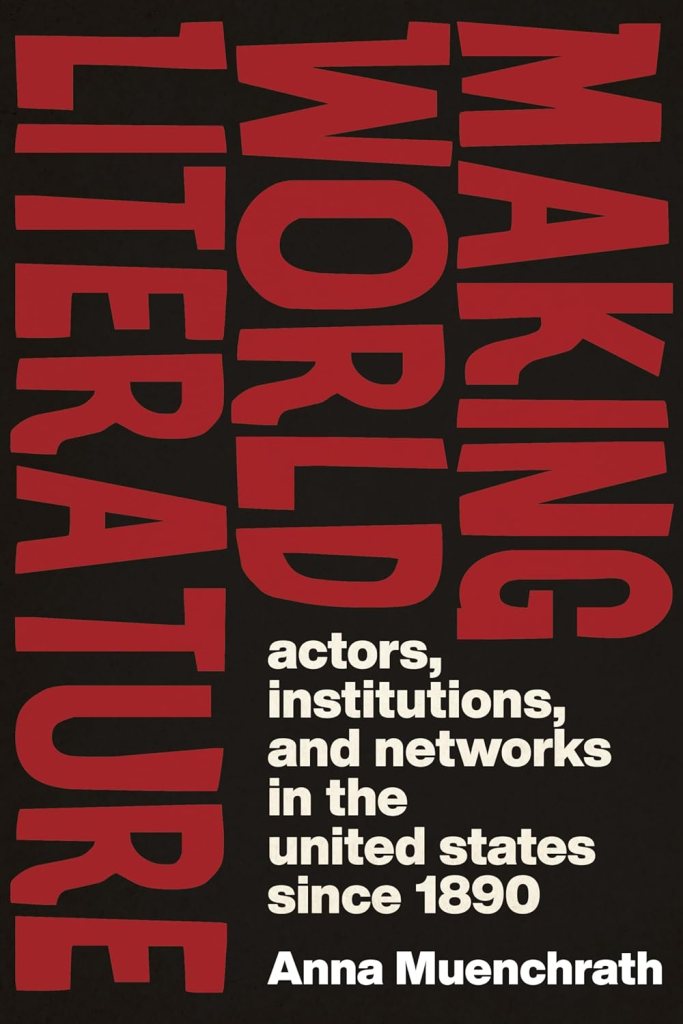
From universities to governments, the Big Five publishers to Amazon, the influence of institutions abounds in US publishing. A diverse array of books from around the globe have been made into world literature in the US, selected by editors, publishers, and bureaucrats, produced by non-profits and for-profit presses of all sizes, and distributed through schools, publishing programs, and bookstores. The resulting world literary canon is the product of complex negotiations between individual preferences and institutional mandates, as well as economic, cultural, and pedagogical logics. While book publishing has fallen increasingly under the sway of global capitalism, yet the literary world remains made up of a series of individuals making choices about whom to fund, teach, translate, edit, and publish. The “world” of world literature, Anna Muenchrath argues, is a heterogeneous network of people whose circulation of literature is necessarily imbricated in the market economy, but whose selections might resist that economy and open new literary futures. Through archival research and close readings, this book considers what those participating are trying to do in circulating a text, and what communities they are helping to form or strengthen.
Making World Literature posits that network theory can effectively model the agency of actors and institutions in the literary field, making visible both the long-term accrual of power, as well as the choices of authors, translators, editors, and readers who do not simply replicate the values of a global literary marketplace, but divert, question, and undermine them. Muenchrath closely examines the paratexts and archival documents surrounding moments of global circulation in and through institutions like US world literature anthologies, the Council of Books in Wartime, the Iowa Writer’s Workshop, Oprah’s Book Club, and Amazon’s translation imprint. The granularity of these case studies reveals the increasingly limited agency of the individual in the global literary field, demonstrating how such players are important actors, and how their choices open up further options for later actors seeking to take texts down new paths toward or after publication.
Selling Books with Algorithms
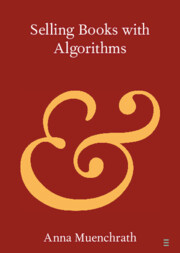
In 1997 Amazon started as a small online bookseller. It is now the largest bookseller in the US and one of the largest companies in the world, due, in part, to its implementation of algorithms and access to user data. This Element explains how these algorithms work, and specifically how they recommend books and make them visible to readers. It argues that framing algorithms as felicitous or infelicitous allows us to reconsider the imagined authority of an algorithm’s recommendation as a culturally situated performance. It also explores the material effects of bookselling algorithms on the forms of labor of the bookstore. The Element ends by considering future directions for research, arguing that the bookselling industry would benefit from an investment in algorithmic literacy.
Teaching
I’ve taught an interdisciplinary class on modern civilization, survey classes on World Literature to 1650, and 1650 to now, a course in 20th and 21st century literature, a literary theory course, as well as an upper-level world literature seminar called and a graduate course on the Institutions of World Literature. I am currently teaching a capstone research seminar in the humanities.
 Anna Muenchrath